
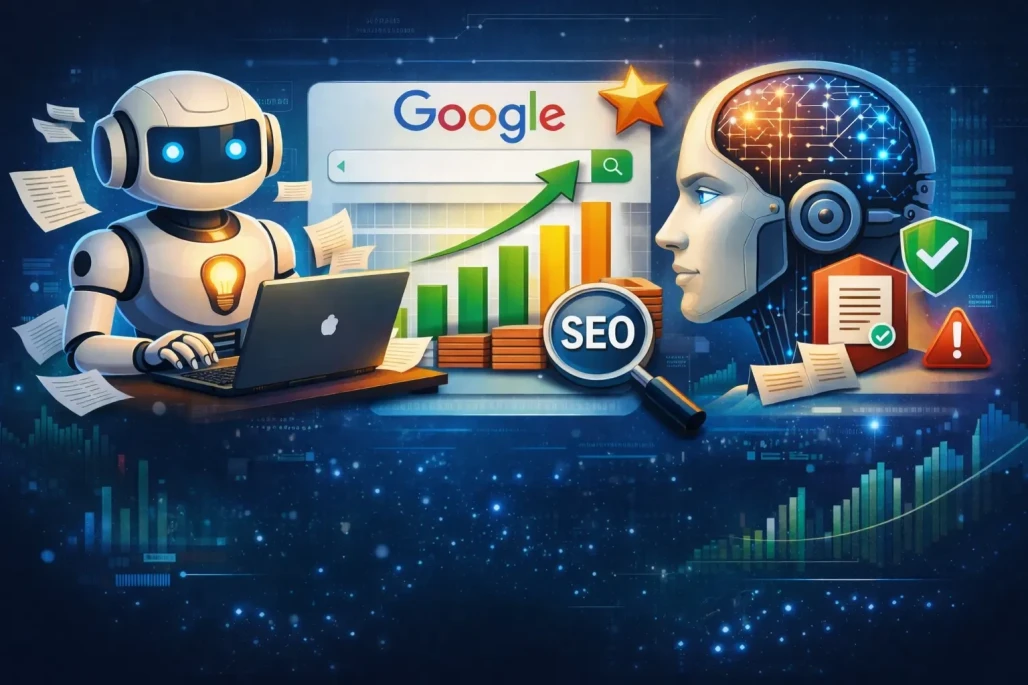
How to Rank on Google Using AI Content Without Penalties

The emergence of artificial intelligence has completely transformed the process of creating, optimizing, and ranking content. Tools such as ChatGPT and other large language models (LLMs) enable marketers to generate content on a large scale, but there are certain limitations. If used incorrectly, AI-generated content can harm your rankings instead of improving them.
Search engines, especially Google, have evolved. They no longer reward content simply for existing they reward value, relevance, and intent alignment. That means AI content must be strategically created using LLM and semantic SEO to rank safely and effectively.
In this guide, you’ll learn how to rank on Google using AI content without getting penalized and how to turn AI into your competitive advantage.
Understanding Google’s Position on AI Content
First, let’s clear a common misconception:
Google does not penalize AI content just because it is AI-generated.
What Google actually penalizes are the following:
- Low-quality content
- Spammy or auto-generated text with no value
- Content created only to manipulate rankings
Google’s helpful content system focuses on:
- Expertise
- Experience
- Authority
- Trust (E-E-A-T)
So the real question is not "Is AI content allowed?"
It's "Is your AI content actually helpful?"
What is LLM Semantics SEO?
Traditional SEO focused on the following:
- Keywords
- Backlinks
- Technical optimization
But modern SEO, especially with AI, is about semantic understanding.
LLM Semantics SEO means the following:
- Writing content that matches user intent, not just keywords
- Covering topics deeply, not shallowly
- Using contextual relationships between ideas
For example, instead of repeating a keyword like "Best SEO Services in Pakistan," you naturally include the following:
- Related services
- Use cases
- Benefits
- Comparisons
- Real-world applications
This creates topical authority, which Google rewards.
Step 1: Start with Search Intent (Not AI)
Most people make this mistake:
They open an AI tool and immediately ask it to write a blog.
That’s backwards.
Instead, start by analyzing:
- What users actually want
- What’s ranking on page 1
- What gaps exist in current content
There are 4 types of search intent:
1. Informational
2. Navigational
3. Transactional
4. Commercial
For example:
If someone searches for Affordable SEO Services in Pakistan, they are
- Comparing options
- Looking for credibility
- Evaluating agencies
Your AI content must reflect that intent.
Step 2: Build a Semantic Content Structure
Before generating content, create a topic map.
Instead of one keyword, build clusters:
- Main topic
- Subtopics
- Related questions
- Entities
Example structure:
- What is AI content?
- How Google evaluates content
- Risks of AI-generated content
- Best practices
- Case studies
- Tools and workflows
This ensures your content:
- Covers the topic completely
- Matches semantic expectations
- Competes with top-ranking pages
Step 3: Use AI for Drafting, Not Final Output
AI should assist, not replace, human thinking.
Bad approach:
- Copy-paste AI output → publish
Good approach:
- Generate draft
- Edit for clarity
- Add insights
- Improve structure
- Inject human perspective
Why this matters:
AI lacks:
- Real experience
- Unique opinions
- Industry-specific nuance
Google can detect generic content easily.
Step 4: Add Human Value Layer
To avoid penalties and improve rankings, your content must include:
1. Original insights
Share:
- Your experience
- Industry observations
- Unique frameworks
2. Real examples
Explain:
- How strategies work in practice
- What results look like
3. Practical steps
Give:
- Actionable guidance
- Clear instructions
This transforms AI content into high-value content.
Step 5: Optimize for Entities, Not Just Keywords
Modern SEO relies heavily on entities.
Entities are:
- People
- Brands
- Tools
- Concepts
For example:
Instead of repeating keywords, include:
- ChatGPT
- SEO tools
- Marketing frameworks
This helps search engines understand:
- Context
- Relevance
- Authority
Step 6: Maintain Keyword Discipline
You still need keywords, but use them smartly.
Primary keyword usage
Use a digital marketing agency in Pakistan naturally and sparingly.
Example placements:
- Introduction
- One strategic section
Avoid:
- Keyword stuffing
- Forced repetition
Secondary keywords
Include:
- SEO Packages in Pakistan
- Top Web Development Services in Pakistan
But integrate them contextually, not mechanically.
Step 7: Create Topical Depth (Content Moat)
Thin content won’t rank anymore.
To stand out, your article must:
- *Answer all related questions
- Cover beginner-to-advanced insights
- Provide a complete guide
Think of your content as the following:
A resource hub, not just a blog post
This is how you compete:
- Established blogs
- Agencies
- High-authority sites
Step 8: Avoid Common AI Content Mistakes
Here’s what gets most AI content penalized:
1. Generic writing
AI often produces:
- Repetitive phrases
- Surface-level explanations
2. No real experience
Content lacks:
- Case studies
- Proof
- Specifics
3. Over-optimization
Too many:
- Keywords
- Headings
- Forced SEO elements
4. No editing
Publishing raw AI output is a major risk.
Step 9: Build Trust Signals
To rank safely, your content must show credibility.
Add:
- Author bio
- Experience
- Case examples
- Clear explanations
For example, if you’re offering services as a digital marketing agency in Pakistan, demonstrate the following:
- Past work
- Results
- Industry knowledge
This aligns with Google’s E-E-A-T principles.
Step 10: Combine AI + Human Strategy
The winning formula is
AI Speed + Human Strategy = Ranking Content
Use AI for:
- Drafting
- Structuring
- Idea generation
Use humans for:
- Strategy
- Editing
- Insights
- Final polish
How This Applies to Businesses in Pakistan
For businesses targeting competitive markets like Pakistan, AI SEO offers a huge advantage.
If you provide:
- Best SEO Services in Karachi, Pakistan
- Top Web Development Services in Pakistan
You can use AI to:
- Scale content production
- Target multiple keywords
- Build authority faster
But success depends on:
- Quality
- Strategy
- Consistency
Final Thoughts
AI content is not the future; it’s the present. But blindly using AI will not get you rankings.
To succeed:
- Focus on user intent
- Build semantic depth
- Add human value
- Avoid shortcuts
Google rewards content that helps users, not content that just exists.
If you apply LLM semantics SEO properly, you can:
- Rank faster
- Scale efficiently
- Outperform competitors
And most importantly, you can do it without risking penalties.
Key Takeaway
AI is a tool, not a strategy.
The real advantage comes from how you use it:
- Thoughtfully
- Strategically
- Creatively
Master that and ranking on Google becomes much easier.






0 comment